Welcome to a Scintilla of Playful Musings

Welcome to my new blog, noos anakainisis, translated literally as mind renewal. The primary obsessions are neuroscience, computation, information, structure, form, art and history of science. Some environmental, political, and technological developments will also be included.

I hope your neurons are sufficiently stimulated...
ENTER
Showing posts with label growth. Show all posts

Tuesday, June 15, 2010

parastychies and fibonacci phyllotaxis

Alan Turing's First Computational Biology Graphic


Alan Turing did some interesting work on morphogenesis, inspired and influenced by D'Arcy Thompson's "On Growth and Form", mentioned in an earlier post. Check out the powerpoint talk.

Dictyostelium

Like the waves in a BZ Reaction (Belousov-Zhabotinsky), a lawn of starved Dictyostelium cells is imaged using phase contrast microscopy. Cells signal via spiral waves of cAMP, and population territories form with a fruiting body in the center of each. To visualize the spirals, use has been made of the fact that when the cells experience a high concentration of cAMP surrounding them, they elongate (called polarization). When that happens the optical density of the cells changes which can be captured by the specific type of microscopy used:


A model based on physarum:

A series of experiments testing maze-solving in dictyostelium:

Thermodynamics of flows determine natural form


A 1917 book by D'Arcy Thompson, called 'On Growth and Form', disregards genetics and biochemistry, providing more of a natural philosophy in a pioneering effort to explore the mathematical principles that underlie biological form. D'Arcy studied the similarity between the shapes of a jellyfish and a drop of ink, a splash and a hydroid, between dragonfly wings and bubble froth, the growth of radiolaria and snowflakes, the spirals of nautilus and mollusk shells and sheep horns.


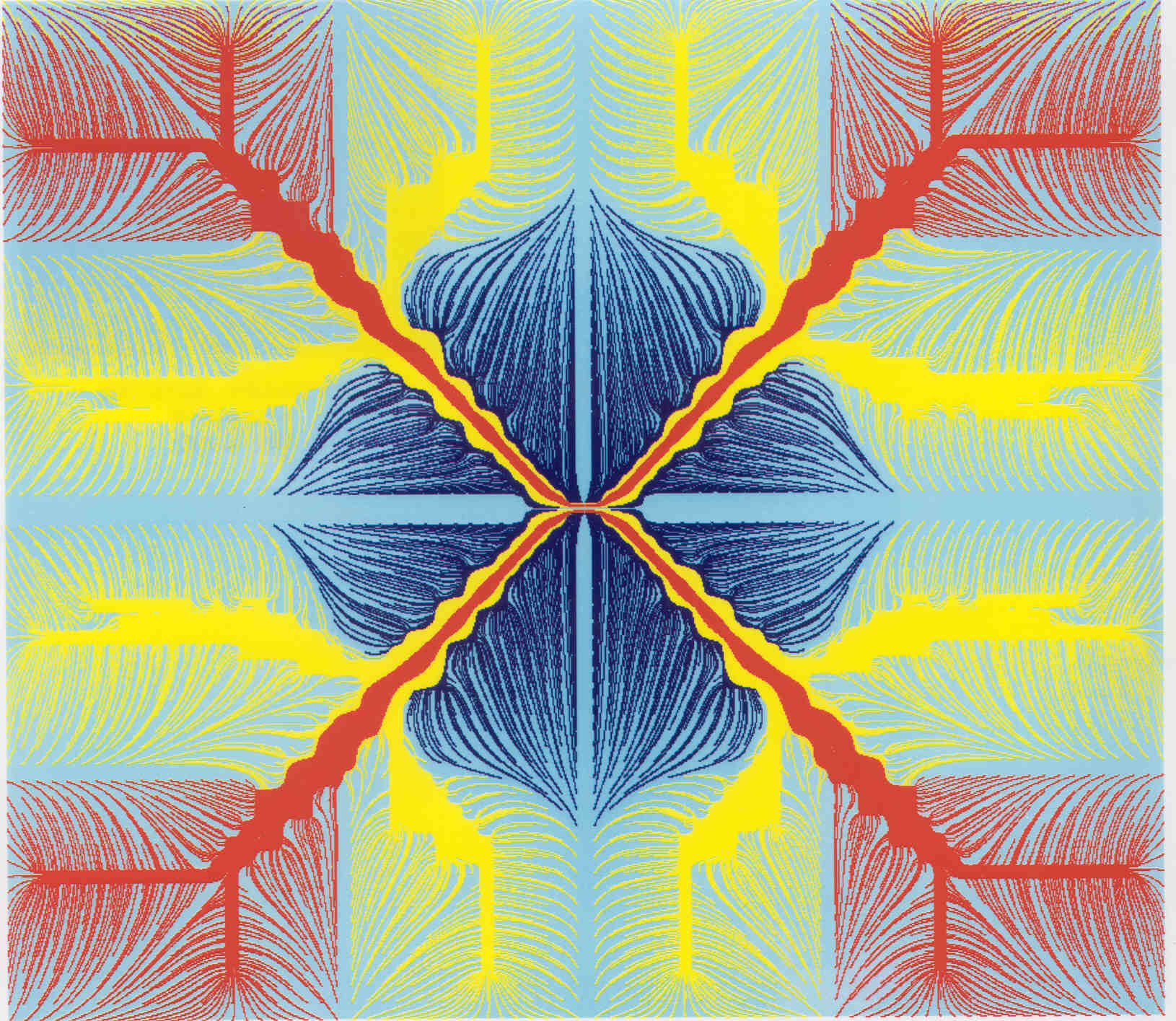
More recently, Adrian Bejan's Constructal theory aims to explain all biological design in nature from one thermodynamic principle. The central principle of Constructal Theory: for a finite system to persist in time (to live) it must evolve so currents can flow easier through it. This idea is used by Bejan to predict the structure of trees and other natural networks, to understand running/swimming/flying, generally to think about the design of everything that flows and moves.